


Full Sequence High-Altitude Drop Test - ExoMars
Vorticity conducts final high-altitude drop test for the ExoMars Rosalind Franklin Mission.
The nHADT1 was the last of ten flight tests of the parachute system for ESA's ExoMars mission. The mission will deliver the Rosalind Franklin rover to the Martian surface using the most complex parachute system ever deployed on Mars. The industrial team - led by Thales-Alenia Space France, with flight test management and parachute systems engineering provided by Vorticity, and balloon flights services from Swedish Space Corporation - created a perfect outcome for this final high-altitude campaign.
Watch the ESA-produced film outlining the testing campaign:
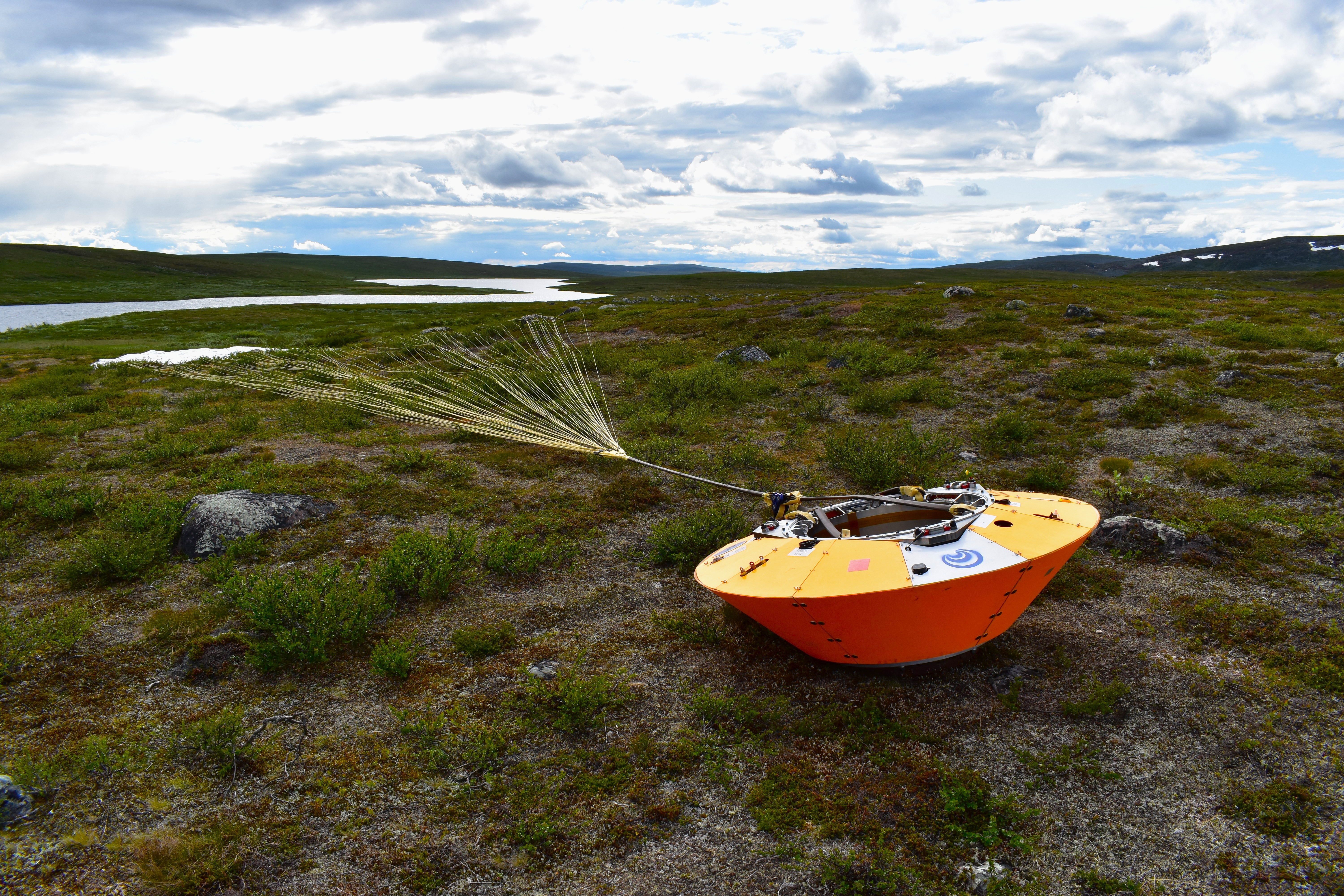
On the 7th July 2025, at Esrange Space Center in northern Sweden, a Vorticity-designed test vehicle was lifted to 29 km altitude beneath a stratospheric helium balloon. The vehicle, weighing nearly a tonne, was released over Esrange’s secure impact area. It began a descent profile carefully designed to reproduce the extremely low density and high entry speeds expected at Mars, where the atmosphere is only 1% the density of Earth’s at sea level.
Upon release, the test article entered a 20-second free-fall, accelerating to nearly the speed of sound. An adaptive timing targeting algorithm, developed by Vorticity, precisely triggered the parachute deployment sequence to ensure that the intended loads, velocities, and atmospheric conditions matched Mars-representative targets. All four stages of the parachute system deployed nominally, including the two main canopies: the 15-metre first main parachute and the 35-metre second main parachute, the latter being the largest parachute ever built for use on Mars or indeed anywhere in the Solar System beyond Earth.
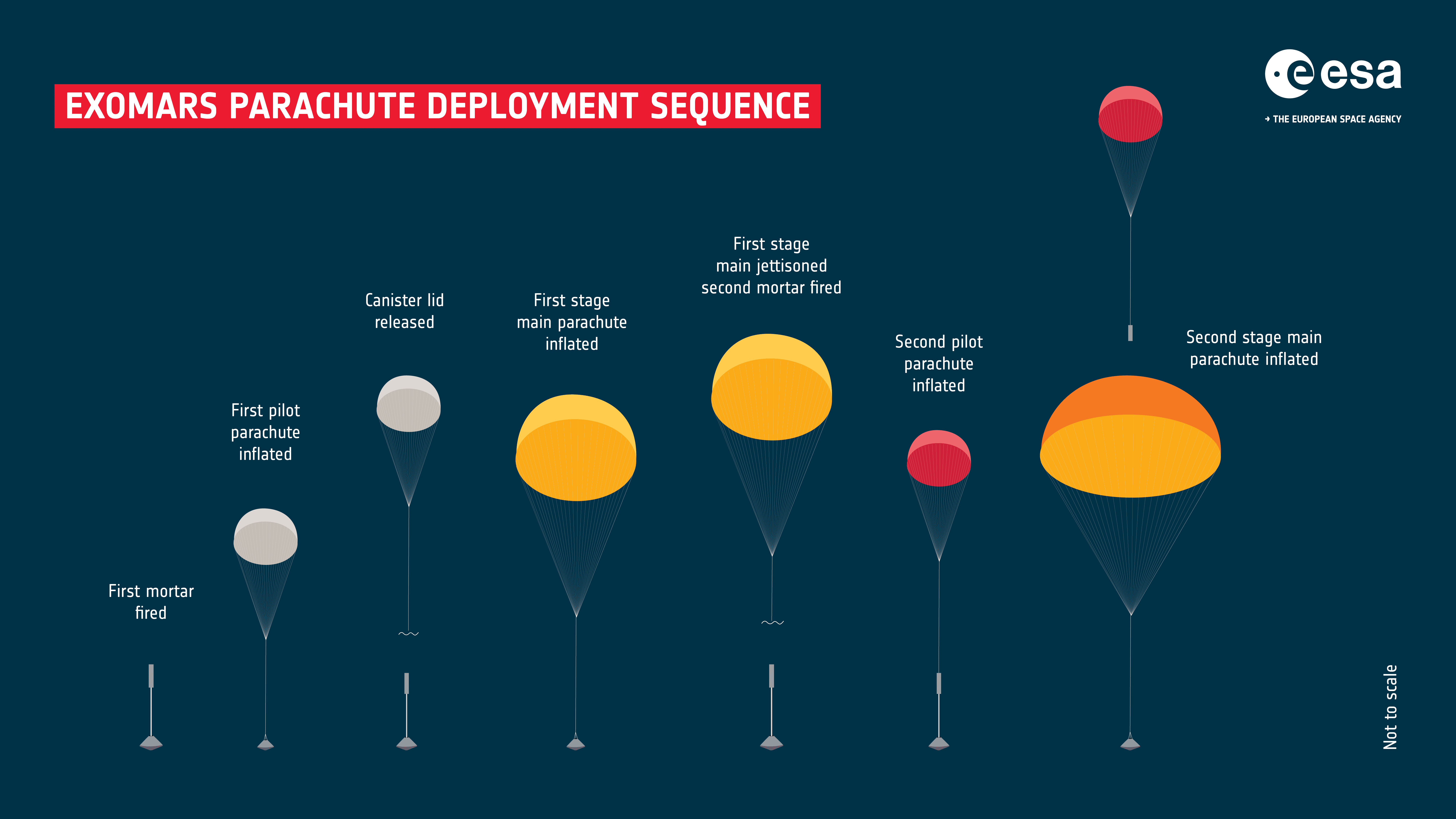
ExoMars parachute deployment sequence (ESA)
Vorticity’s technical role extended across the entire test campaign. Vorticity provided Monte Carlo simulations of the parachute system, including loads, extraction velocities, and deployment dynamics; consulted on parachute design; produced the adaptive timing algorithm central to achieving the required test conditions; designed and manufactured the test vehicle; and delivered the full instrumentation suite and data analysis for the campaign. The resulting data set captured attitude, rotation, speed, loads, and onboard video through every stage of descent.
Conducting a test of this scale demanded precise coordination across launch, flight, and recovery operations. Thanks to Esrange’s unique stratospheric balloon heritage and vast recovery area, SSC was able to provide the stable flight trajectories and safe landing conditions required for such a critical campaign. Following touchdown in northern Sweden, the test vehicle was retrieved for detailed inspection and analysis.
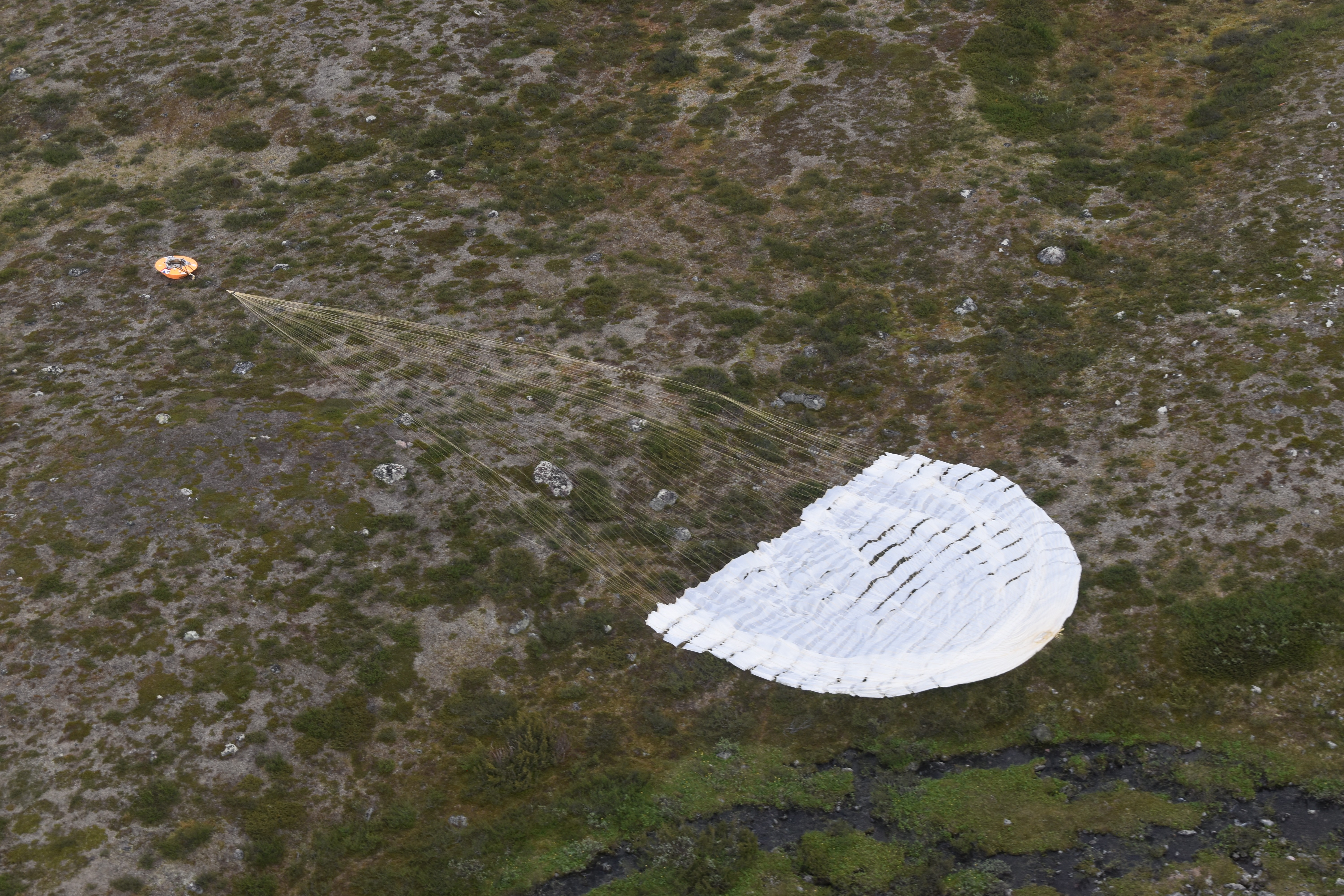
Vorticity's drop test vehicle with the second main parachute seen during recovery
This successful drop test marks one of the final major demonstrations needed before ExoMars proceeds to launch. During the real mission, the descent module must slow from 21,000 km/h at the top of the Martian atmosphere to a soft landing in just six minutes, a challenge only possible with exhaustive testing of the sort completed in the HADT programme.
ESA is now targeting a 2028 launch, with the Rosalind Franklin rover scheduled to touch down on Mars in 2030. Once on the surface, it will drill up to two metres underground in search of chemical and structural biosignatures of past or present life, providing Europe’s first dedicated rover exploration of the Martian subsurface.
With this high-altitude complete and the parachute system fully demonstrated in Mars-like conditions, the ExoMars mission takes a decisive step towards its long-awaited journey to the Red Planet, and Vorticity’s engineering contributions sit at the heart of that success.
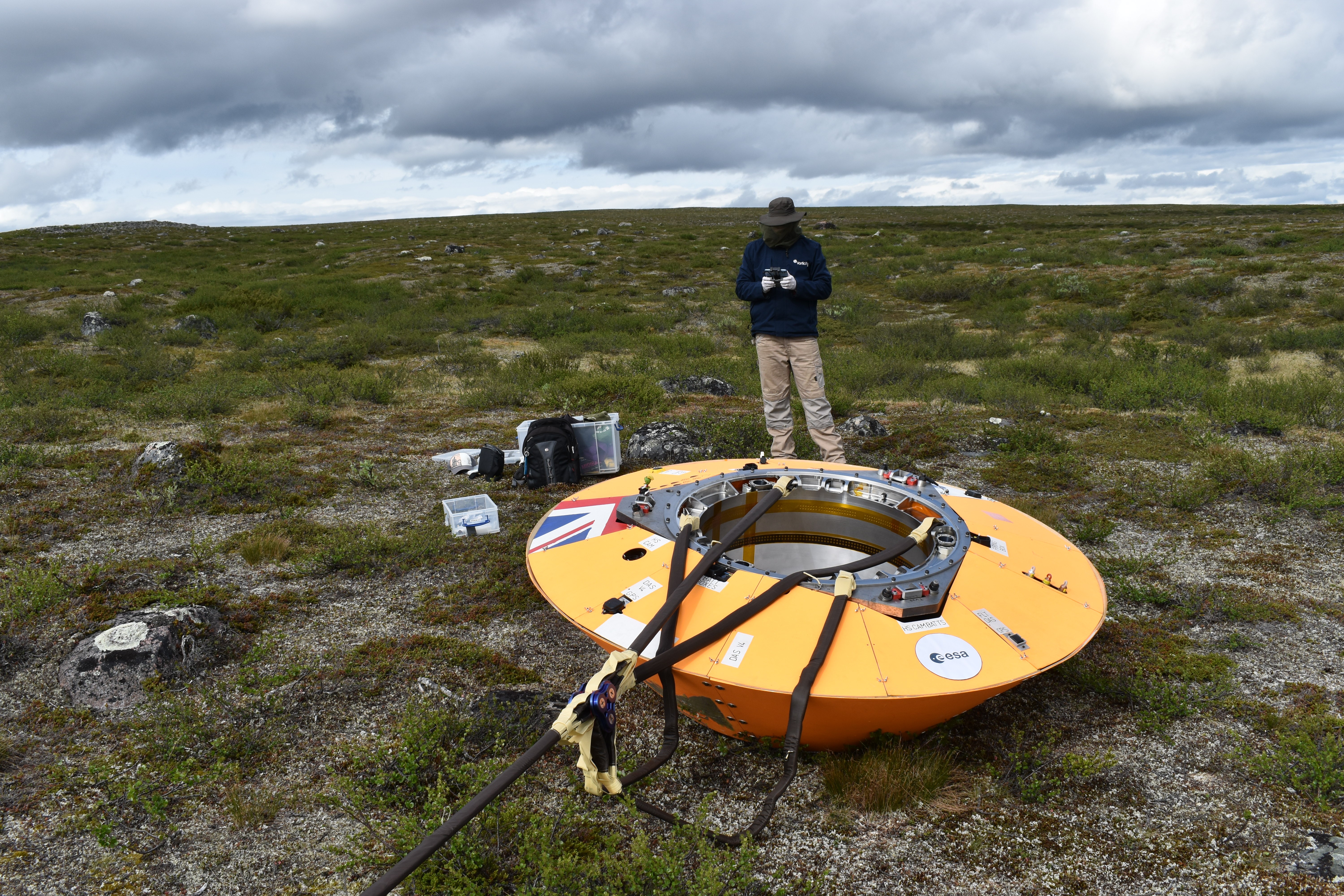
Arrun Saunders (Senior Engineer) pictured with the drop test vehicle