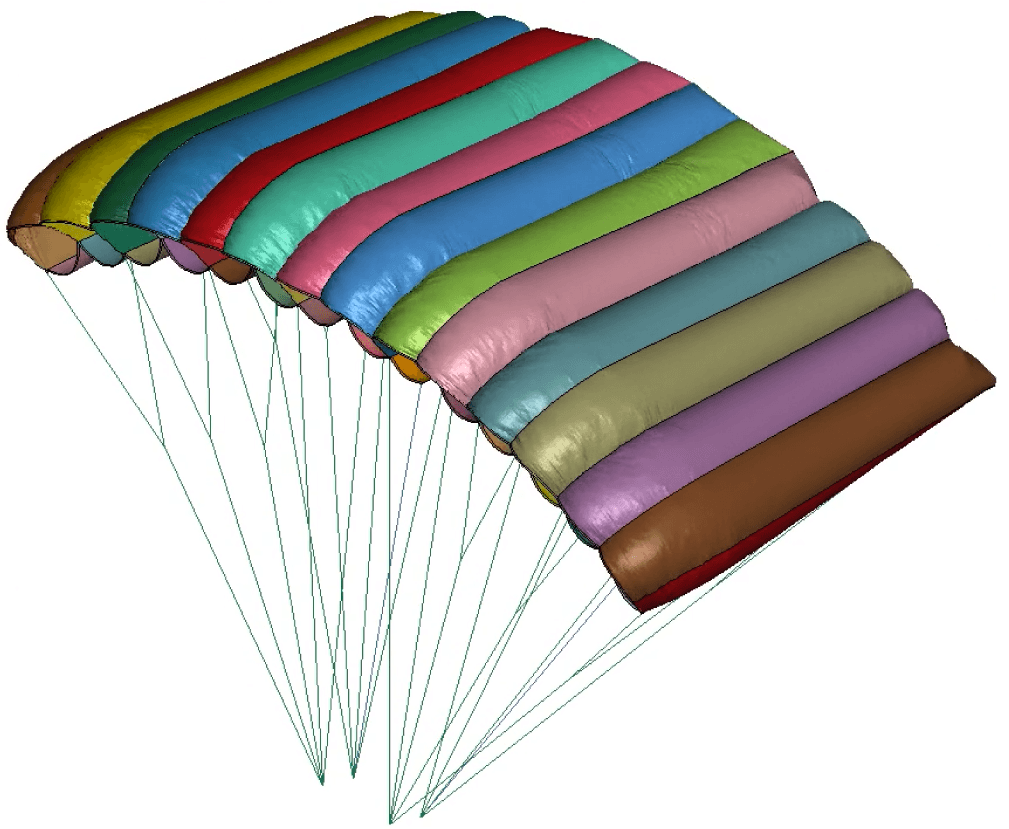
Autonomous Parafoil End-to-End Simulation
Simulation framework for large autonomous parafoil systems including fluid-structural modelling, aerodynamics, mass properties, and closed-loop GNC performance evaluation


Enabling Precision Recovery for Reusable Space Systems
Under an ESA-funded programme completed in 2024, Vorticity developed and validated a scalable, end-to-end simulation framework for large autonomous parafoil systems. This includes fluid-structural modelling, aerodynamics, mass properties, and closed-loop GNC performance evaluation.
From Inflated Shape to Flight Dynamics
Accurate prediction of the inflated canopy geometry is fundamental to reliable flight modelling. Using LS-DYNA, Vorticity simulated canopy inflation and control deflections to derive realistic flying shapes. These geometries were used to generate aerodynamic databases, added mass terms, and inertia properties. Accurate added mass modelling is essential for realistic simulation of parafoil dynamics under steering control.
A dedicated model captured the significant drag contribution of suspension lines. This is particularly important for large canopies, where line drag can exceed 20% of total system drag. Parametric mass models were also developed to support rapid design iteration.
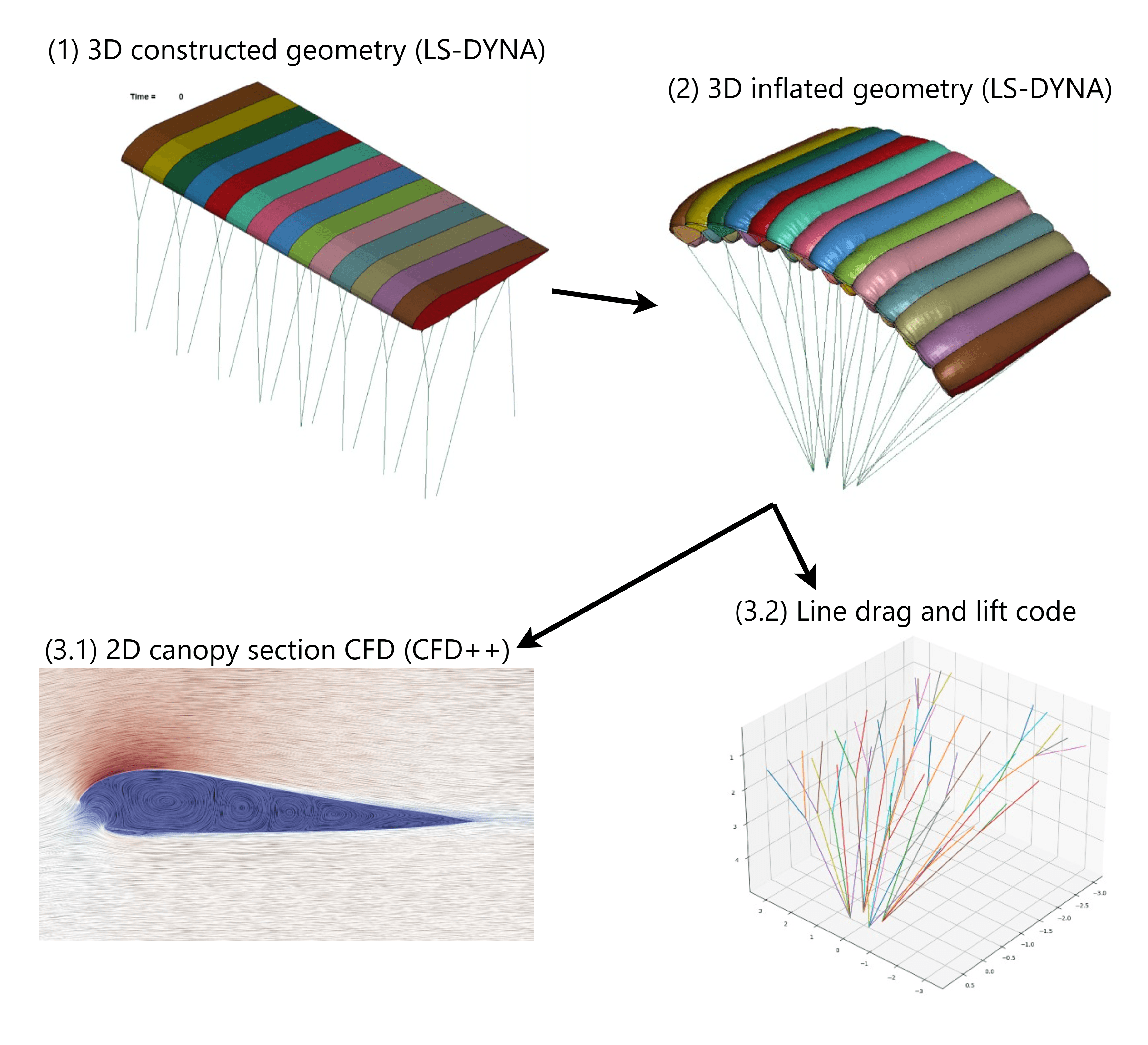
Parafoil aerodynamic analysis sequence
Closed-Loop GNC Simulation and Validation
All properties were integrated into Vorticity’s proprietary multi-body flight dynamics and trajectory simulation code, Anybody6D. The performance of any commercial GNC algorithm can be simulated in-the-loop, allowing different algorithms to be assessed. The simulation environment modelled the full descent from deployment to touchdown, under realistic varying atmospheric and turbulence conditions.
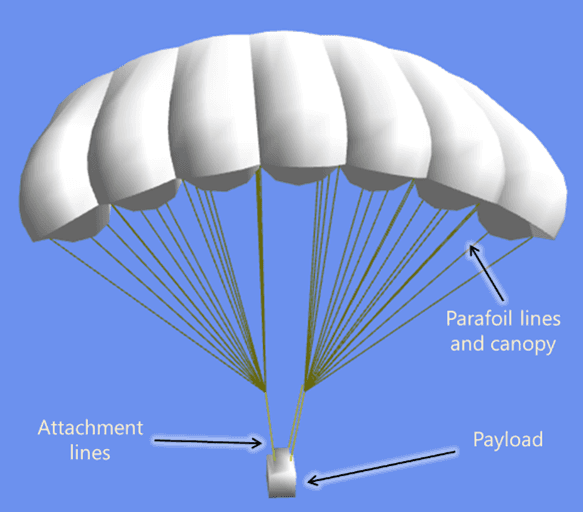
Anybody6d model
The framework was validated against flight data for a 36 m² MC-4 parafoil. Simulated ground tracks, altitude profiles, and landing dispersion closely matched real-world performance, confirming the accuracy of the modelling approach.
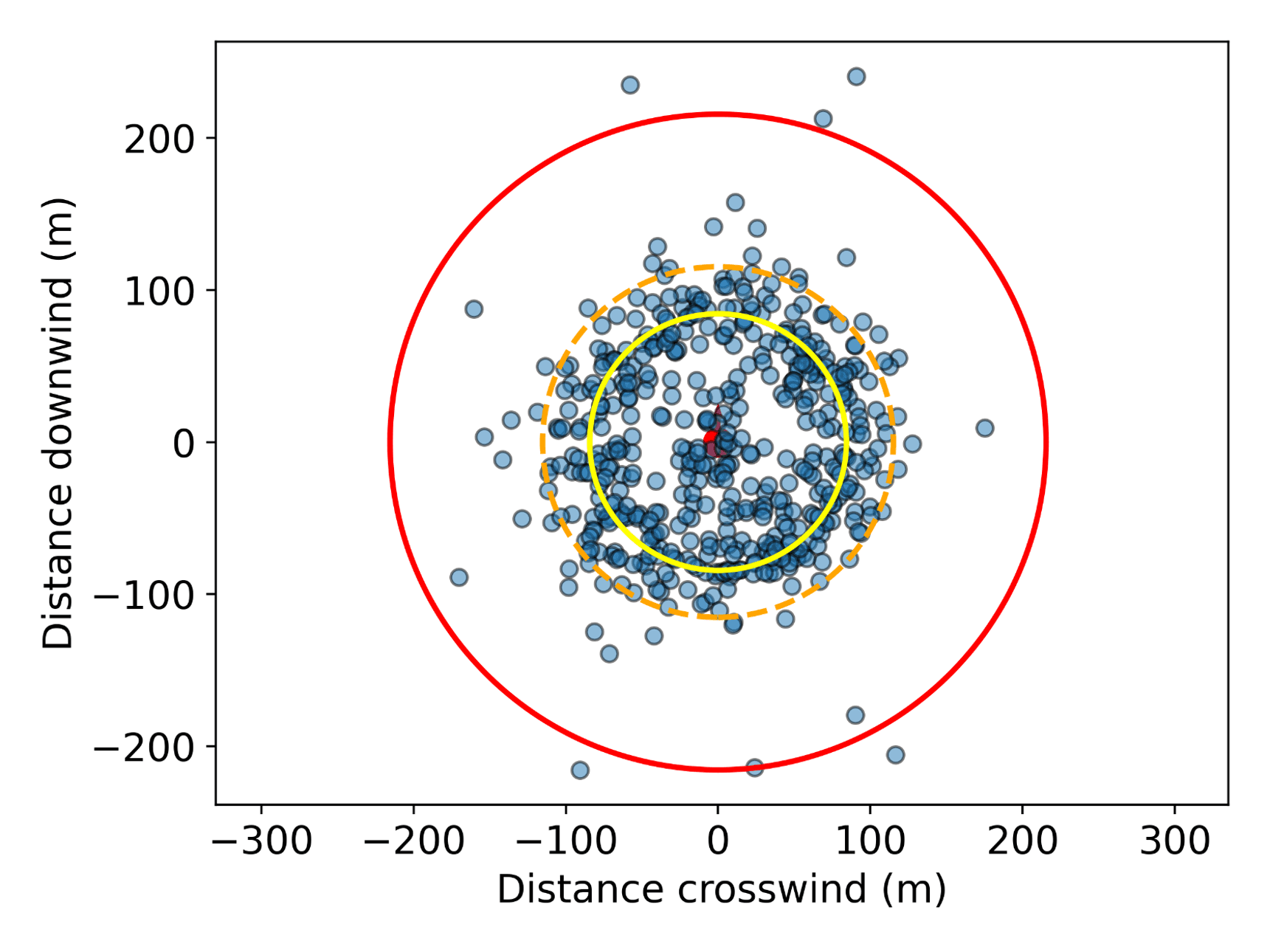
Monte Carlo simulation landing points
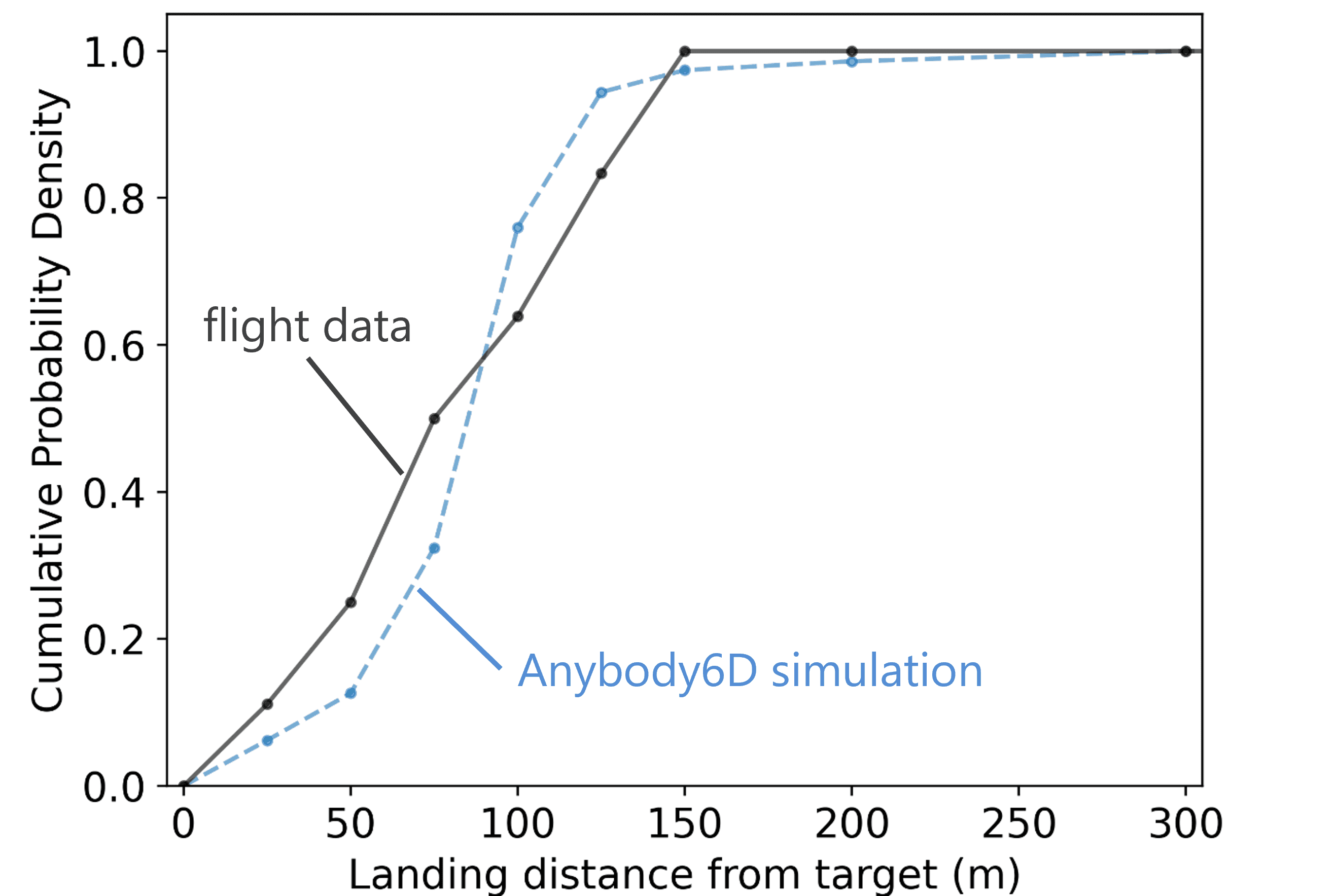
Landing accuracy comparison of Monte Carlo simulations to flight data
Scaling to Heavy Payload Recovery
The validated methodology was then applied to a 211 m² canopy designed to recover a 2500 kg payload from space. Monte Carlo simulation campaigns quantified landing accuracy and touchdown speeds under aerodynamic and wind uncertainties. Results demonstrated predictable, stable performance and provided clear insight into control authority limitations for larger systems. These results were used to inform future GNC optimisation.
A Digital Testbed for Parafoil GNC Development
This project delivered a modular, validated digital environment for designing and tuning autonomous parafoil systems. By combining structural FEA, aerodynamic modelling, and in-the-loop trajectory simulation, Vorticity enables early-phase performance assessment and risk reduction — from small payload systems to multi-tonne space recovery missions.